
Refresher on Quasi-Judicial Rules
Time to remind everyone of the rules of Quasi-Judicial proceedings.
On Friday, a news article and video from Tampa Bay 28 came out discussing data centers and potential environmental impact. It seemed innocent enough, until County Commissioner Jeff Kinnard was shown during the interview talking about the Deltona application for expanding the Holder Industrial Park (HIP).
Uh.. What was he thinking?
This is a project with a pending application. It is under Quasi-judicial rules which means they can ONLY consider what is presented to them at the hearing.
We hear it all the time. Commissioners act like judges and jury. The applicant is one party... and staff is another. If there is an intervenor, they are an additional party. Like a court trial, each side present their "case". They bring in experts to "testify" to the facts of the case. They make arguments showing how their project will fit the comp plan and LDC... or how it doesn't fit those things and should be denied.
The hearing is basically two or more parties telling the judge/jury why they think it should be approved or not approved.
But key in all this is "competent substantial evidence". That is the burden that the parties have to meet. Commissioners can only approve projects if competent substantial evidence exists to approve it. They have a little more leeway to deny projects, particularly zoning cases, but still, they rely on evidence being presented.
Where does this evidence come from?
The presentations during the hearing, much like evidence comes out during a trial. It is essentially the same exact thing. The parties submit their documents to be included in the official record. Commissioners can then view those documents in advance and ready any questions they may have. They then listen to the presentations and ask those questions.
They are NOT supposed to do outside research. They are NOT supposed to ask staff questions outside of the hearings. They are NOT supposed to listen to anything EXCEPT what is presented during the hearing.
Doing so jeopardizes the ruling they make and opens the county to a lawsuit to overturn the results.
Now, prior to August 12, 2025, Commissioners were not supposed to have any contract with anyone outside of the hearing. That meant staff, members of the public, developers, etc. Once the application was filed, it was supposed to be radio silence and no conversations about that project.
Well Commissioners do what they do and had conversations. They could be "disclosed" at the meeting by simply stating "Yes" when asked if they had ex-parte communication.
Without getting too in-depth, that violated the Jennings v Dade County ruling from 1991 which stated that ex-parte communication was presumed to be prejudicial to a hearing if not disclosed properly. This required not only a "yes" answer, but also disclosure of the topic, who they spoke to, etc.
The idea here is that if they are speaking with people outside of the hearing, the other parties needed to be aware of those conversations so they could potentially dispute them. This requires commissioners to disclose what they talked about... otherwise how would anyone know? Just stating "Yes" is not full disclosure.
They passed a new ordinance requiring disclosure in August 2025. That requires this form to be filled out.
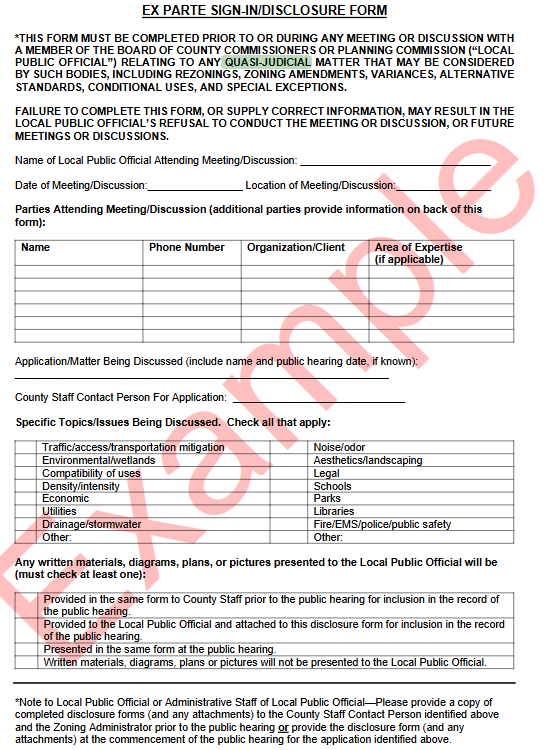
At the last BOCC meeting, two commissioners stated they had ex-parte communication (Barek and Davis) but that they had not filled out the form to disclose that, as required. Apparently they did so at the meeting, but not sure if they turned it in before the vote, as required. This did not give an opportunity for those in attendance to review the extent of the ex-parte communication and be able to refute it if desired.
Fast forward to Friday and the news article/video where Commissioner Kinnard interviewed for it.
This is ex-parte communication. This jeopardizes the case because the applicant can argue that Kinnard is no longer unbiased. The article was regarding the potential negative aspects of a data center and a sitting commissioner is talking about those things.
Imagine a judge giving an interview about your case before your attorneys had a chance to present it.
That is the same thing here. Horrible decision that may hurt Citrus County and cost tax payers money down the line should this be appealed for this reason... and it very well could.
Also, do not be surprised if Deltona tries to get him tossed from the hearing. Not sure how exactly that would help them, but if they feel he is not unbiased towards it and leaning towards a "NO" vote, they may do just that.
In any case, just because we have the form now for disclosure does not mean it is open season to speak with whoever, whenever. There are still risks in doing that and remember, no one has really challenged the law that the state passed to try to satisfy Jennings. Commissioners can still run afoul by having those communications and it is only a matter of time before it happens here.
To all the commissioners, think about that risk before deciding on that next chat, interview, etc. Just because you may think you have the ability to talk to whoever, does not mean that you should.