
De-facto Meeting?
A few weeks ago, I was browsing through some records that I requested in regards to the school zone cameras that the board discussed with the Sheriff in May. I wanted to see how involved staff was in the process with the Sheriff's office (very involved).
One thing that stood out is how long it took to get it to the board. I found emails going back to September where Captain Justin Ferrara approached the county with the idea (the cities would hear about it at meetings in October). Despite staff working on it with the CCSO, it took over 7 months to get this to the board.
It was not for staff's lack of trying. Rather, it appeared to be a lack of direction from their boss... Steve Howard. I wrote last week about issues I have seen recently.
But I found something more concerning. This email.
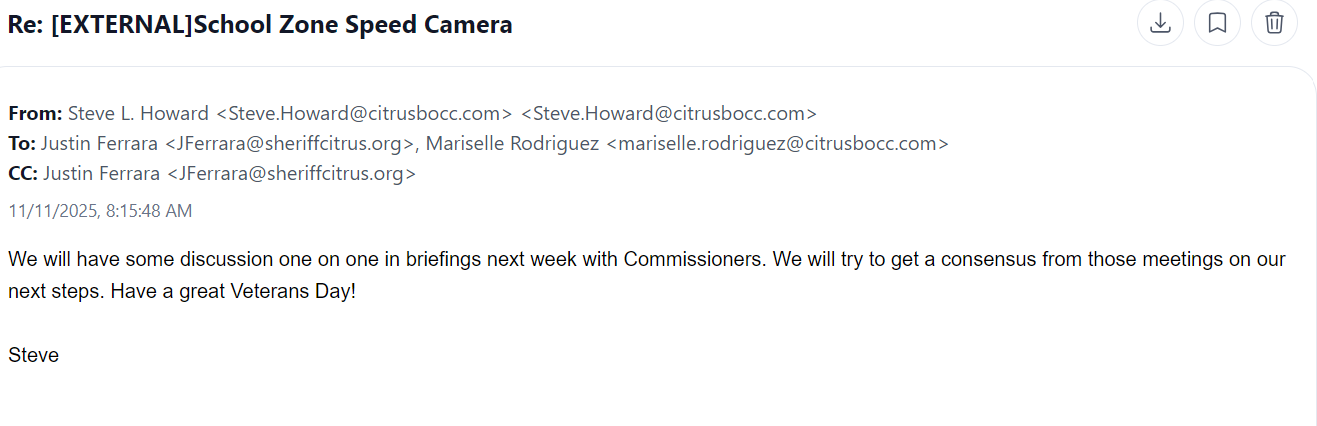
This is Howard responding to Ferrara's email.
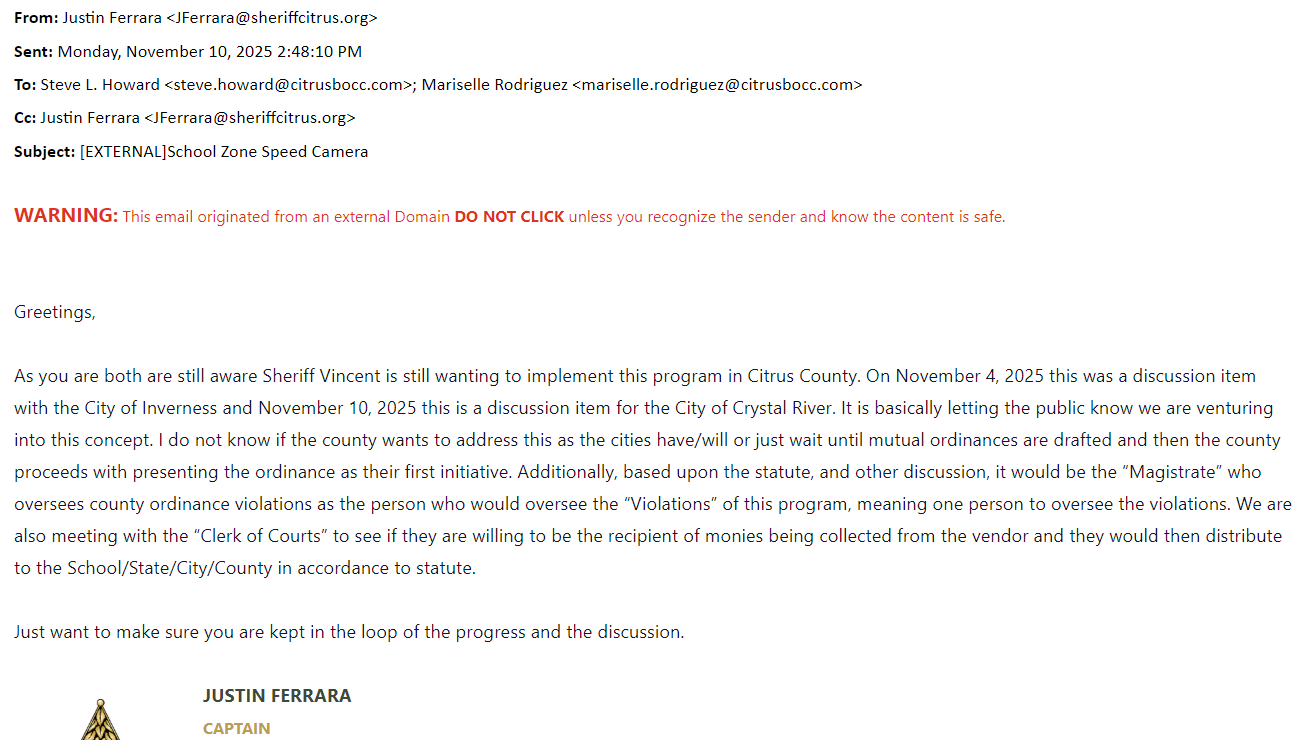
Why is this alarming?
Howard is telling Ferrara that he will work to get consensus from them on the next steps for this potential project. Why is this not being discussed at a public meeting? Why is Howard working behind the scenes to get commissioners to decide a course of action?
This should have been a public meeting. Howard should have put this on the agenda and asked them how they would like to proceed. Remember, they cannot speak with one another outside a public meeting. Bring it to them and let them have a discussion.
Speaking with them 1 on 1 does not allow for them to discuss the issue and decide collectively how they would like to proceed. This was not some top secret project or anything, why do it in private?
The other reason it is alarming... Well it looks like he is speaking to them individually, but how does he build consensus without telling them what the others said?
Here is the definition of "Consensus" from Merriam-Webster:
"General agreement (as of opinion or fact) among a group of people or things"
Why is that an issue? Florida Sunshine Laws
You see, people cannot act as a conduit between elected officials. If a commissioner tells someone something about an upcoming vote/discussion/etc and that person goes and tells another commissioner... that is a violation of law.
From Attorney General's Office (AGO 89-23).
"This office has determined, similarly, that the Government in the Sunshine Law is applicable when a person other than a board member is used as a liaison among board members. For example, a city manager should refrain from asking each commissioner to state his or her position on a specific matter which will foreseeably be considered by the commission at a public meeting in order to provide the information to the members of the commission."
It is possible Howard did not tell the commissioners what the other commissioners said. He could have asked them "What do you think of school speed zone cameras" and used that answer to decide whether to move forward or not. If the majority of the 5 said they didn't want them, well no reason to bring it forward.
However, there was a court ruling that states meetings in quick succession can lead to a violation of Florida Sunshine Laws. This case was Blackford v School Board of Orange City. A Superintendent met with school board members one after another to help craft a response to a district issue.
"Thus on January 30, 1978, the board proceeded in convoy, but out of sight of each other, to the superintendent's office, the first at 8:30 A.M., the second at 10:30 A.M. and the third at 12:30 P.M. Two days later three more members did the same..."
This case is referenced in the 2026 Government in the Sunshine Manual on page 10. The key takeaway here:
"While normally meetings between the school superintendent and an individual school board member would not be subject to s. 286.011, F.S., these meetings were held in “rapid --fire succession” in order to avoid a public airing of a controversial redistricting problem. Thus, even though the superintendent was “adamant that he did not act as a go-between during these discussions and [denied] that he told any one board member the opinions of the others,” the one-to-one meetings amounted to a de facto meeting of the school board in violation of s. 286.011, F.S."
Howard does briefings with commissioners on Mondays before BOCC meetings. It is possible several did not show up. It is possible he never had the discussion.
But... If he met with them that day (or just two of them separately) and discussed the school speed zone cameras with them to "get a consensus", can it be argued these become "de-facto meetings" under the Blackford decision and thus a violation of Florida Sunshine Laws?
I will let you make that determination on your own.