
Competent Substantial Evidence
We had a lot of conversation yesterday about the asphalt plant application in Crystal River. A few people mentioned emailing commissioners and letting them know their displeasure. That certainly never hurts, but let's talk about what it should be and how you can make an impact on these cases.
Remember, these hearings are Quasi-judicial. This means that the members of the board (both PDC and commissioners) act as judges. As such, they are to focus on what is presented as evidence and make their ruling on what is called "competent substantial evidence".
This includes things like staff reports, expert opinions/reports, and so on.
Do you know what does NOT count? How many people speak for or against the application... and that includes emails, petitions and so on. If 500 people attend the meeting or send emails or sign petitions and say that they don't like the project, the board cannot use that information as competent substantial evidence... because it is just opinion.
Courts have ruled many times regarding this.
- City of Apopka v. Orange County - The court cautioned that quasi-judicial decisions should not be controlled by the “opinions and desires” of the public at hearings.
- Pollard v. Palm Beach County - Lay neighbor testimony expressing fears or opposition — without factual, technical support — is not competent substantial evidence.
- Town of Ponce Inlet v. Rancourt - Neighborhood sentiment cannot substitute for evidentiary proof.
This means the following types of comments in emails or in person should not be considered by the board as evidence.
- “We don’t want this.”
- “This will ruin our community.”
- Generalized fears about traffic, crime, or property values without expert foundation.
- Emotional arguments untethered to the rezoning criteria.
If residents want what they say to count in the deliberations, they need to present factual evidence.
In the instance of the asphalt plant, residents need to show studies that have been done around other asphalt plants to show how they affect things like air quality, water quality, truck traffic and so on. These things need to be included in the emails or mentioned while speaking at the meeting.
Election year aside, that is where Pine Ridge was successful the first time. They had a ton of people reading from a script about zoning law and other related issues. These were not opinions of residents... they were presenting evidence as to why it should not be allowed.
This is also why Tuscany was approved. The residents that spoke there did not really bring evidence to back up their claims. They had mentioned things like roads and water, but no evidence to support their opinions.
Watch the staff presentation during these hearings. They represent a side in the hearing and present evidence to the board for consideration. The staff report is full of information about traffic, water, the comp plan, the LDC and so on. If you want an easy argument to make, review the staff report and pick something from there to bring up.
Take the data center for instance. This application is NOT for a data center. It is to rezone residential areas into industrial areas and to expand the use within those to allow a data center.
Anyone getting up to speak against a data center should be ignored by the board as the application is not for a data center. They can talk about the issues that would come if the zoning change were to be approved... industrial is not supposed to go next to residential due to the comp plan.
Or take this quote from the staff report and mention that this use seems to be too intense for the area as central utility availability should not indicate a project is good for that area.
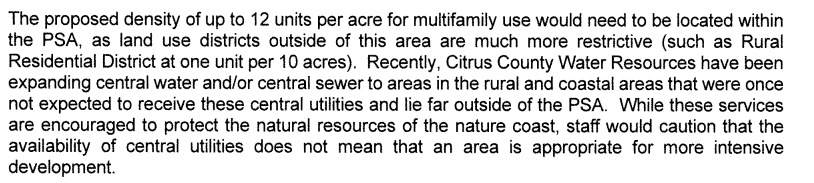
That is your competent substantial evidence.
My challenge to all those who oppose many of these projects, or speak for them... rather than just firing off emails to the board or showing up and telling them your opinion, find evidence to show them why it is good/bad for that area. Takes a little bit of research, but will actually provide something for the board to use in their decision.
And importantly, if you are going to email these things to commissioners, make sure that you include Joanna Coutu in the email and not just send it to commissioners. If the commissioners do not send them to Ms Coutu, they never make it into the packet for the hearings. They do not have a very good track record of sending them to Ms Coutu.
You can email her at: joanna.coutu@citrusbocc.com